
Harford County Deed Records by Instrument Type
The Circuit Court for Harford County records more than deeds. Mortgages, releases, easements, covenants, liens, and plats all sit in the same deed records. The label matters. Not every instrument transfers ownership at all. Before trusting any result, read the parties, the legal capacity, the legal description, the recording date, and the liber and folio reference. Those fields tell you what the document actually did.
| Deed Type | What It Does | Common Use |
|---|---|---|
| Deed | Conveys the interest described in the instrument | Sale or other transfer |
| Quitclaim deed | Conveys whatever interest the grantor has without a title promise | Family or corrective transfer |
| Trustee or representative deed | Records a transfer in a stated legal capacity | Trust, estate, or court transfer |
| Mortgage or deed of trust | Records security rather than a new owner by itself | Financing |
| Release or satisfaction | Releases a prior claim or security instrument | Resolved obligation |
An easement, right-of-way, declaration, or plat can bind the land without conveying the whole parcel. Keep that distinction in mind. A recorded deed proves recording, never a complete or clear title.
Find a Harford County Deed from an Address
Maryland Land Records has no address search for Harford County. Use the SDAT Real Property Data Search instead. Select Harford County, then save the owner display and the deed book and page. If the address fails, drop its direction and suffix, omit the street number, or truncate the street name with an asterisk. Small tricks loosen a stubborn search.
Next, open Maryland Land Records and use Jump to New Volume with the clerk, book, and page. This SDAT bridge beats guessing among similar party names. MDLandRec requires a free account in its current repository.
Fields in the Harford County Deed Index
MDLandRec offers name, party, document, date, and reference controls for narrowing deed records. Preserve the exact index spelling. Keep the legal capacity with every result you record.
| Index field | Use | Caution |
|---|---|---|
| County or clerk | Limits the repository to Harford | Choose the correct series |
| Party name | Locates grantors and grantees | Try exact, begins, contains, fuzzy, or Soundex |
| Party type and capacity | Separates transfer roles | Trustees and representatives may be indexed by capacity |
| Document type | Narrows deeds, mortgages, and releases | A full chain may span several types |
| Date range | Targets a likely recording period | Recording can follow settlement |
| Book and page | Opens a known liber and folio | Do not confuse deed and plat references |
Walk the Harford County Grantor-Grantee Index
Start with the current acquisition deed and read its prior reference. Maryland deeds often introduce an earlier book and page with phrases like “being the same as.” That citation is the cleanest link to the preceding transfer in Harford County deed records.
- Open the latest deed and record the grantee, grantor, type, date, legal description, and book and page.
- Find the cited prior book and page in its text and open that volume.
- If there is no prior reference, search the earlier owner as grantee with name and tract variants.
- Repeat while the legal description stays consistent, then move to archival books and microfilm.
- Grantor
- The party transferring the stated interest.
- Grantee
- The party receiving the stated interest.
- Chain of title
- The ordered trail of recorded transfers for the same land.
- Liber and folio
- Maryland's book and page terms for a land instrument.
Harford County Deed Books Reach into the 1770s
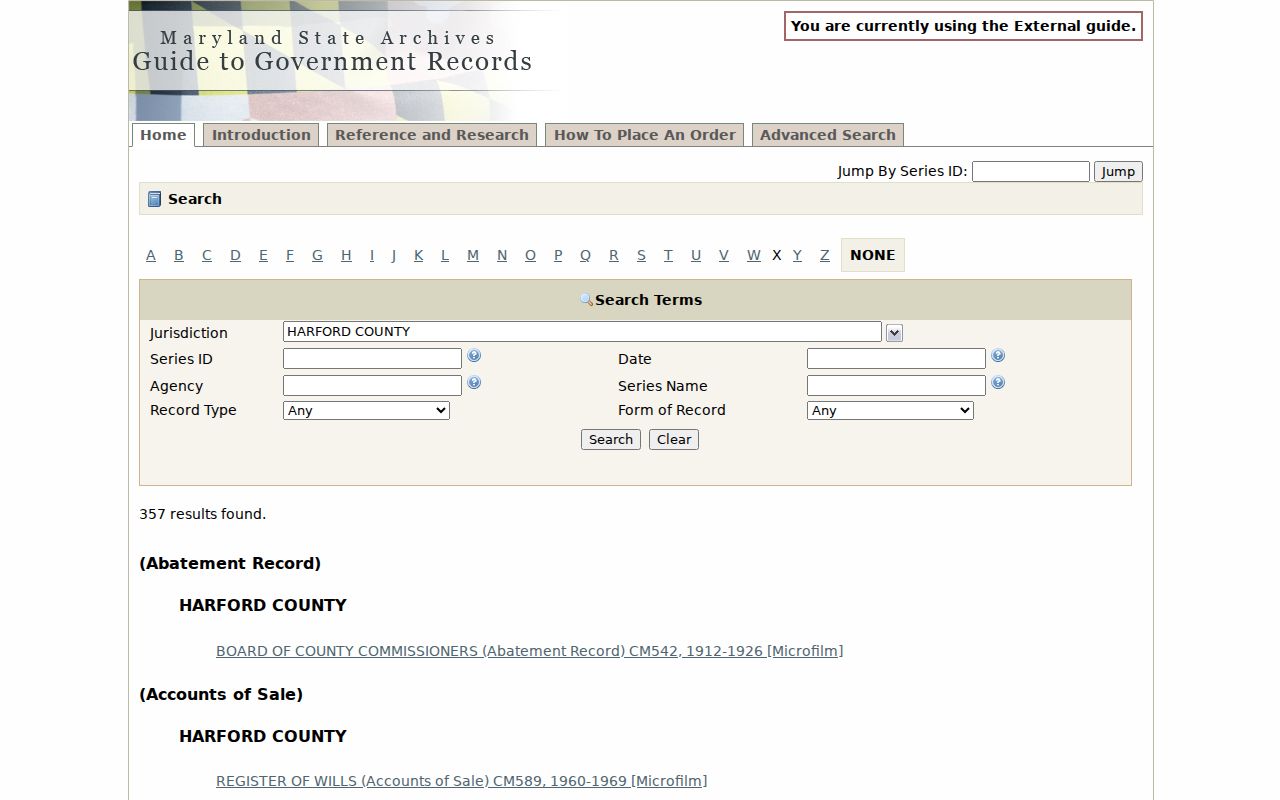
Maryland State Archives guides trace Harford land records and indices back to 1773 or 1774. The starting year depends on the series. The holdings span paper, electronic, book, and microfilm forms. Early examples include AL 1, covering 1774 to 1776. JLG volumes come from the late eighteenth century. Those dates show archival depth, not full online image coverage.
Series C937 covers court land records from 1774 to 1791. CM574 and CM576 preserve early land records and indices on microfilm. The current online cutoff is not published. So identify the series, book, container, or reel before asking the clerk or Archives for an older deed record.
The Maryland State Archives Harford guide inventories these older holdings.
Match Harford Deeds to Recorded Plats
PLATS.NET searches Harford material by book, page, plat or box number, and right-of-way reference. Advanced controls add date, description, clerk initials, and sort order. Archives series C2446 covers land-record plats from 1779 to 1849. C2460 holds county road plats from 1935 to 1962. C2451 carries survey records dated from 1658 to 1894.
A subdivision, tract, developer, road, section, block, or lot can connect an old deed to a current parcel. That link matters after a street name changed. Compare the plat against the deed description and the GIS map. A surveyor settles a present physical boundary. The web map does not.
Harford County Deed Copies and Certification
The Clerk of the Circuit Court provides online images where available, counter access, and a request form for mail orders. The form separates ordinary, certified, exemplified, and plat copies. State the exact book, page, and copy type you need.
| Ordinary copy | $0.50 per page |
|---|---|
| Certified copy | $0.50 per page plus $5 |
| Exemplification | $0.50 per page plus $15 |
| Plat | $5 per plat |
For a certified copy of a deed or other land record, call the clerk's land-record department at 410-638-3474. Staff will handle copies and certifications, though they cannot run a title search or offer legal advice on a property.
Read Harford County Deed Records with Care
Record complete party names, capacities, instrument type, execution and recording dates, page count, legal description, prior references, and liber and folio. A release may follow a mortgage. An assignment may change its holder. An easement may sit in a separate instrument or plat within the Harford County deed records. One deed is never the whole trail.
Recorded, not guaranteed. Harford County deed records show what reached the land books. They are not a title opinion and do not rule out later, disputed, or unrecorded interests.
When a Harford County Deed Trail Breaks
A gap in the deed chain is rarely a dead end. Go back to the grantor and grantee indexes and work the name from every angle. Exact spellings come first, then variants. Try Begins With, Contains, Fuzzy, and Soundex searches. Layer in the tract, subdivision, plat, adjoining owner, and legal capacity. Narrow the date range before giving up on a line. Older indexes carry their own mistakes. Preserve spellings exactly as written. Let the legal description, not the name, confirm that two entries belong to the same Harford County parcel.
Estate transfers can break a tidy seller-to-buyer chain in a single step. Name the decedent and the personal representative. Check the probate docket, then return to MDLandRec for the representative instrument. An obituary or a library genealogy file adds color, but only the recorded conveyance counts as evidence. For an old tract, the Harford County Public Library Maryland Room, the Harford History Center PastPerfect catalog, and historical newspapers can surface a forgotten road or tract name. That name may finally open the land index.
Harford's first court convened at Bush Town in 1774. Its records have since moved through courthouse books, microfilm, archival series, and digital platforms. One chain may shift format several times. Keep a running table of every transfer date, party, deed type, book, page, and image or series citation. That discipline keeps the evidence tied to the same parcel across every format change. Note whether each item is an index entry, an image, a plain copy, or a certified copy. The forms serve different purposes. A readable screen image may still fail the requirements of a filing or other formal use.
Encumbrances demand a parallel review of their own. MDLandRec confirms that mortgages sit in the land books. Yet a recorded mortgage alone proves nothing about the current balance. Chase down the assignments, releases, and satisfactions tied to the parties and the reference number. Easements and restrictions can hide inside a deed, a separate agreement, a declaration, a right-of-way plat, or a subdivision instrument. Preserve each citation. Silence in one deed is never proof that a parcel carries no burden.
People and companies also surface in Maryland's separate Judgment and Liens Search. Confirm an entity's exact legal name through Maryland Business Express before searching the court or land index. A UCC fixture filing against real property goes to the Circuit Court clerk. Other UCC services stay outside the assessment system. These searches strengthen a deed review. They do not replace a professional examination of title.
Preserve the Harford County Deed Evidence
Build a separate inventory for every instrument. Log the execution date, recording date, grantor, grantee, legal capacity, document type, liber, folio, page count, legal description, consideration if shown, and every prior or related reference. Later records can amend, assign, release, satisfy, or correct earlier ones. Chronology therefore matters as much as party names.
Harford GIS owner, transfer, liber, folio, plat, section, block, and lot fields are finding aids. They never substitute for the deed image itself. Match them against SDAT and the land books, especially after a transfer or a lot split. When records disagree, preserve each source date.
Harford County publishes no deed-fraud alert signup. The county Fraud, Waste and Abuse page is not an enrollment service. Watch the clerk's official page for announcements. Verify any suspicious recording demand through published office contacts.
A finished deed review should separate the record's forms. An index points to the filing. An image permits inspection. An ordinary copy reproduces it, and a certified copy adds clerk certification. A historical image may answer a house-history question yet remain unsuitable for formal use. State the exact book, page, and copy type when contacting the land-record department, and keep the returned certification or receipt with the chain inventory.