
Trace Former Harford Owners Backward
Every chain starts with the current SDAT deed reference. Work one transfer at a time. Maryland's official help tells users to open the deed and hunt for a prior reference such as “being the same as.” That phrase points to an earlier liber and folio. When it is missing, search the earlier party as grantee or grantor instead.
| Transfer Date | Grantor to Grantee | Deed Type | Book/Page |
|---|---|---|---|
| Newest verified recording | Current deed grantor to present grantee | Record the exact instrument label | Current liber/folio |
| Prior recording | Earlier owner to the current deed's grantor | Warranty, quitclaim, representative, or other recorded type | Prior citation in the deed |
| Earlier recording | Repeat with the prior grantee | Preserve the index wording | Index, book, reel, or series reference |
This table is a blank working timeline. It is not a sample chain for a real person. A transfer earns a row only after the legal description or parcel clue confirms the same Harford County land.
Reconstruct Harford's Deed Chain
MDLandRec's official search help maps the backward route. Harford addresses are not searched there. SDAT supplies the first book and page, and the county, clerk, book, and page jump then lets each deed point to its predecessor.
- Find the present parcel in SDAT and copy the newest liber and folio.
- Open that deed and record the grantor, grantee, type, recording date, legal description, and prior citation.
- Jump to the prior book and page. If none is stated, search the current deed's grantor as an earlier grantee.
- Repeat until the web path ends, then carry the exact citation into the clerk, Archives guide, deed books, or microfilm.
- Grantor
- The party transferring the recorded interest.
- Grantee
- The party receiving the recorded interest.
- Chain of title
- The linked sequence of instruments affecting ownership.
- Reverse index
- An index organized to help search a party in the opposite deed role.
- Quitclaim and warranty
- Different deed forms whose legal effect must be read from the instrument, not guessed from the index label.
Follow Harford's “Same As” Clue
A “being the same as” phrase often carries the prior liber and folio inside a deed. That makes it the cleanest key to previous owners. A direct citation beats a broad name search. Copy it exactly, then confirm the earlier legal description matches the tract, subdivision, lot, easement, or boundary under review.
If the deed lacks the clue, MDLandRec offers exact, begins-with, ends-with, contains, fuzzy, and Soundex modes. Retired indexes can hold misspellings or weak cross-references. Preserve each spelling exactly. Standardizing it silently can break the chain.
The official backward-chain example in the Maryland Land Records help page shows the method in practice.
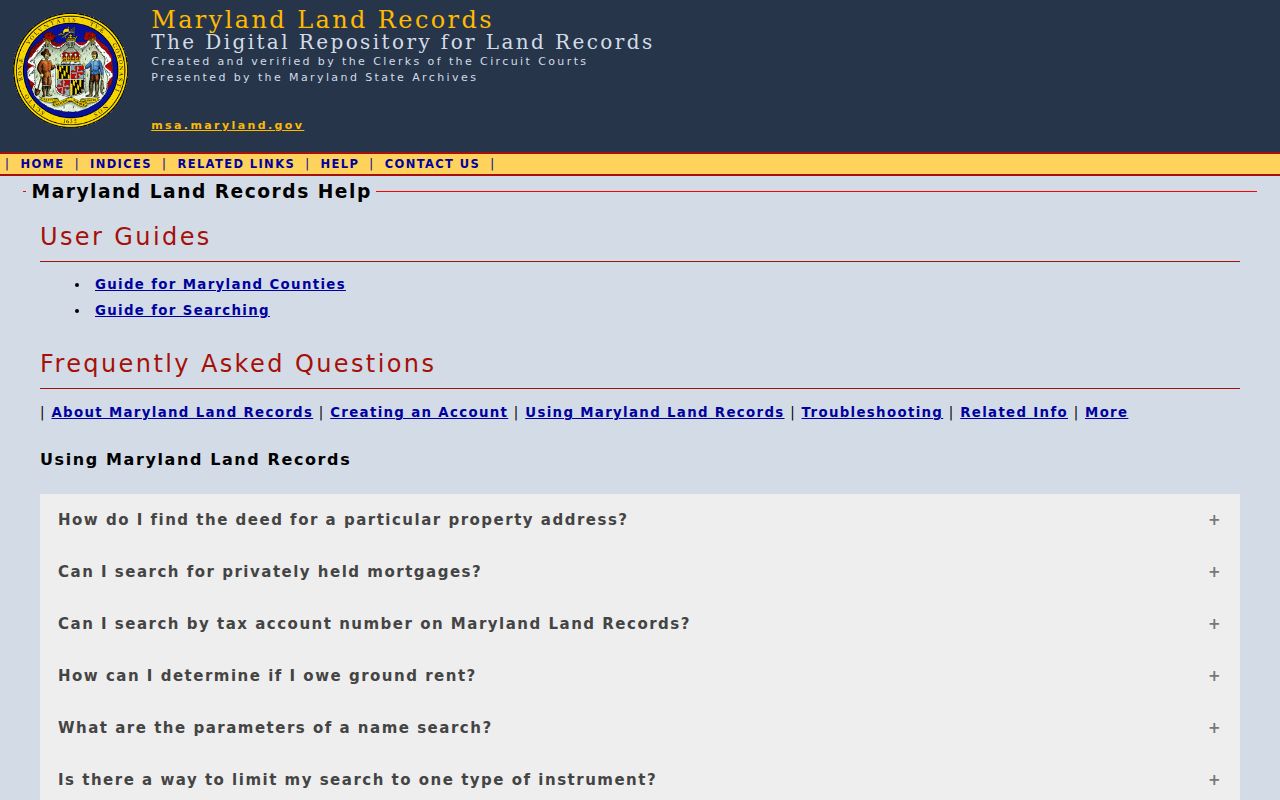
The prior book and page moves a Harford County chain backward. No modern street address is required.
Harford Ownership Records Reach Back
Harford County's ownership records reach deep. The Maryland State Archives guide traces Harford land-record and index series to beginnings in 1773 or 1774. Early CE113 books include AL 1. Several JLG volumes join them. Series C937 covers court land records from 1774 through 1791, while microfilm series CM574 and CM576 hold early records and their indexes. That depth is not a promise that every image or name is searchable online.
Online cutoff not verified. Harford's active MDLandRec range is dynamic and no exact web cutoff was stated. Older former owners may require microfilm, paper deed books, a courthouse terminal, or an Archives series request.
Clerk access covers terminals, counters, mail, phone, and copy forms. The Maryland Archives supplies series, container, and reel context. Note any format shift. A chain can drop from electronic image to paper or microfilm.
Match Former Owners to Harford Plats
Old deeds rarely name modern addresses. Plats fill that gap. Harford PLATS.NET accepts book, page, plat or box number, and right-of-way searches. Its advanced route adds date, description, clerk initials, and sort controls. The Archives lists Harford plat series C2446 from 1779 through 1849, plus later subdivision records.
Search tract, developer, road, and plat number together. Then compare the recorded plat against the deed description and the current GIS parcel. Splits, mergers, annexation, and renumbering all happen. Any of them can explain why one past owner held land broader than today's parcel.
Harford's archival map series add depth. Survey Record C2451 spans material dated from 1658 through 1894. County Road Plat Book C2460 covers 1935 through 1962. Later subdivision series carry the lot trail forward. The ranges describe whole collections, not a guarantee that every tract is present. Record the series, description, page, and container or reel before requesting an Archives item.
A named place can work when a street fails. The Long Property Subdivision record cites Gilbert Road, Long Drive, lot numbers, I-95, wetlands, easements, and stormwater notes. That separates the right plat from a similar name. Its book and page, lot, road, and deed references then reconnect the historic tract to the current parcel.
Estate Transfers in Harford Chains
Some prior owners vanish from the sale trail because death and probate intervene. Judiciary Case Search can surface an estate number, decedent, status, personal representative, attorney, aliases, and docket entries. Use those legal names in the deed index. Include any representative or trust capacity.
A will, inventory, obituary, or estate docket may explain the transition. None replaces a recorded deed or court order. Those instruments move the property. For older estates, Harford County Public Library's Maryland Room and the Harford History Center offer newspaper, family, tract, and map clues. The search then returns to land records.
The History Center's PastPerfect catalog is rich. It holds books, vertical files, photographs, audiovisual records, and genealogy materials. Its “Marriage Records - Harford County (1865-1899)” entry is an index, not a certified record. Treat such finds as leads. Capture the former road, family, tract, or subdivision name, then verify the ownership link in a deed, plat, estate file, or order.
Harford's Paper-to-Portal Story
Harford County split off from Baltimore County in 1773. Its first court session came a year later at Bush Town. From there the record system evolved. Paper deed books gave way to original indexes. Microfilm followed. Electronic index series came next. Then came the MDLandRec portal used today. So an early parcel may hide under an older county name. It may also hide under a tract, a road, or a town-lot description rather than a modern address.
Start your historic triage from the current parcel and widen outward. Useful anchors include the deed reference. They also include prior party spellings, Soundex searches, Archives series, microfilm, plats, and tract names. Local-history clues help too. That order preserves real evidence instead of forcing a story from a single name match.
Note: at every handoff, record whether your source was an index, an image, a book, a reel, or a finding aid.
Use Former Harford Owners Carefully
Former-owner research in Harford County supports house histories, estate work, recorded title review, and land or subdivision study. But a chain built from public indexes is not a title opinion. One missed spelling, unindexed interest, probate event, or later instrument can flip the conclusion entirely.
Lawful research only. Use former Harford County owners for a property or history question. Do not use a deed chain, mailing field, estate clue, or archive to harass or target a living person.
When a legal decision hangs on the answer, keep every source image and citation. Order copies from the clerk as needed. Then bring the file to a qualified Maryland title professional or attorney.
The clerk offers several channels: MDLandRec, courthouse terminals, walk-in service, mail, and a copy form. Plain copies run fifty cents per page. Certification adds five dollars, and exemplification adds ten dollars plus page costs. Fees change, so confirm them before ordering. A certified historic deed proves only what that filed record contains, not that the chain captures every interest.
Treat gaps as gaps. If a deed, index page, or estate transfer will not surface, never join two similar names as if the missing link were proved. Carry the last firm book, page, tract, and date into the next Harford County search channel.