
Harford County Property Tax Records by Field
A parcel's tax story spans three keepers: SDAT, Harford County Revenue Collections, and the tax-sale files. Trust each value to the office that maintains it. One parcel card will not hold the entire account, so match identifiers across sources before drawing conclusions from any deed, assessment, or tax bill.
| Field | What It Shows | Where |
|---|---|---|
| Market and assessed value | State valuation and assessment fields | Maryland SDAT |
| Phase-in and taxable assessment | Figures used as a reassessment is phased in | Maryland SDAT |
| Exemption or credit fields | Relief reflected on the assessment record | SDAT and the applicable program |
| Tax bill and status | County billing account and payment route | Harford County Bill Pay |
| Delinquency and sale material | Preparation, auction, and redemption records | Harford Treasury tax-sale page |
An assessment is not an appraisal or a sale price. It is a taxable figure the state sets on its own cycle. The tax bill then applies rates and credits to that figure. A deed's consideration field can show a different amount entirely, since it records what a transfer reported, not what the assessor measured.
Look Up a Harford County Property Tax Bill
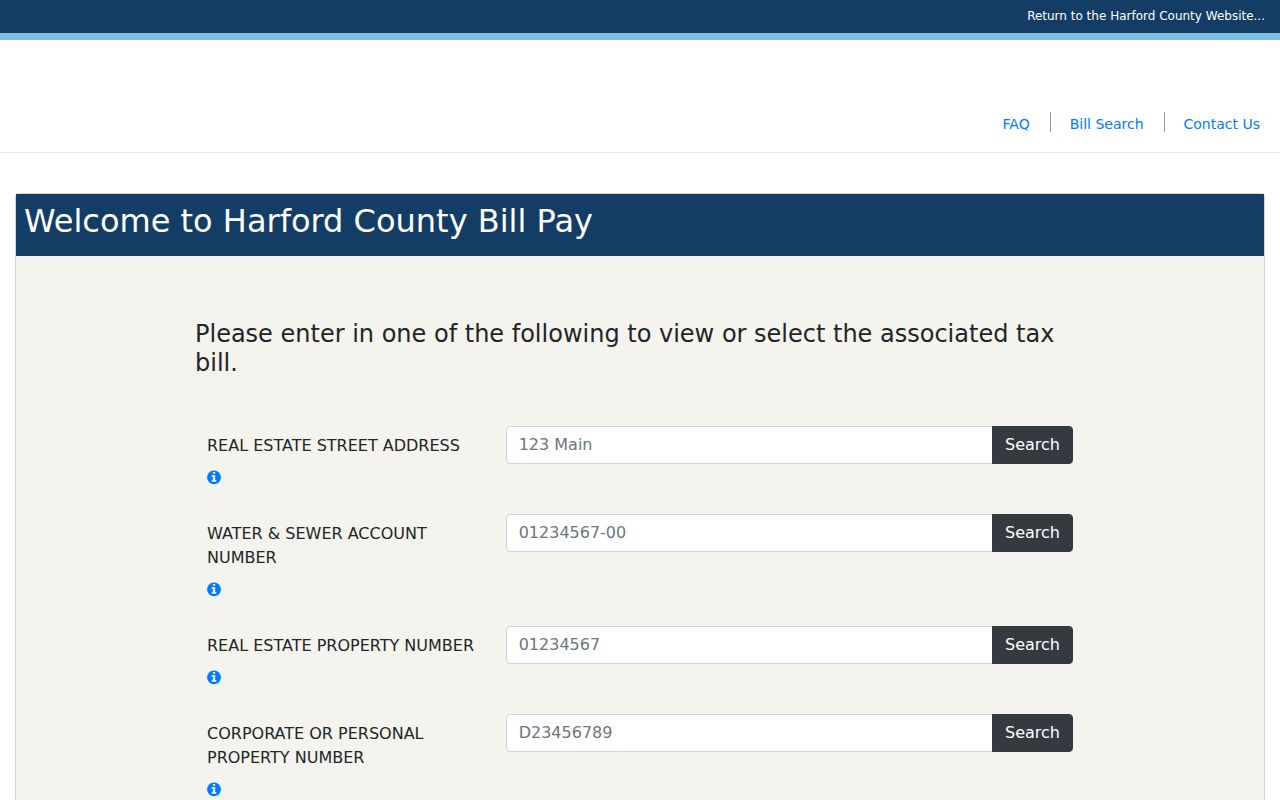
Harford County Bill Pay opens with separate tabs for real-estate street address, real-estate property number, water and sewer, and corporate or personal property. Pick the tab that matches your search. The real-estate address route accepts part of a street name, and it asks users to leave off suffixes, directions, and any letters in the street number.
- Choose the real-estate street-address or property-number tab.
- For an address, enter a partial street name without its suffix or direction.
- For a property number, enter the eight digits without spaces or dashes.
- Match the account to SDAT, then check the current tax-sale page if delinquency is at issue.
- Assessed value
- The state assessment figure associated with the parcel.
- Taxable assessment
- The assessment figure to which applicable tax calculations and credits relate.
- Homestead Tax Credit
- A Maryland program that can limit taxable assessment growth for a qualifying principal residence.
- Tax lien
- A claim arising from unpaid taxes or charges, distinct from a voluntary mortgage.
Harford County Reassessment Areas Rotate Every Three Years
Maryland reassesses real property every three years. Harford County splits its territory into Areas 1, 2, and 3. Each area has its own reassessment year. Two parcels sitting side by side can therefore sit at different points in the cycle. Save the notice year and area with any value comparison. A large increase rarely lands all at once. Maryland phases assessment growth in over the cycle. That is why market value, assessed value, phase-in value, and taxable assessment are four different numbers. Collapsing them into one figure invites error. For the figures tied to a specific parcel, the SDAT record and the assessment notice are the right sources.
Harford Property Tax Records and the Homestead Credit
The Homestead Tax Credit concerns a principal residence. When its requirements are met, it limits growth in the taxable assessment. Do not infer eligibility from an owner or mailing address. SDAT's application and status tools answer the question directly. The official status shows approval, denial, or action still needed. The credit changes the taxable path only. It never alters the recorded deed or the open-market sale price, and a denial carries its own appeal route, separate from any appeal of the underlying assessment.
Harford's 2025 Assessment Ratio Results
The 2025 state assessment-ratio survey put Harford residential property at 93.6 percent. Commercial came in at 94.0 percent. Agricultural matched residential at 93.6 percent, use value reached 100.0 percent, and the weighted total landed at 93.7 percent. These are statistical survey results. Do not multiply them against an individual bill. They show how the state studies assessment levels across broad classes, but a parcel's SDAT record, assessment notice, comparable sales, and formal appeal evidence still do the real work.
Delinquent Harford County Property Tax and Tax Sale
Harford mails annual tax bills on July 1. Paying by September 30 avoids added cost. Unpaid accounts move toward the annual tax sale after April 1. The county advertises delinquent property twice in April. Extra preparation charges begin May 1. Dates and terms can shift, so rely on the current year's official page. The 2025 terms describe an online auction. The county also warns that it gives no warranty of marketable title or acreage. Redemption requests go to the county tax-sale program, and the first three redemptions on a property need no lien certificate, while the fourth or later requires a $50 lien certificate.
The official Bill Pay page shows the distinct address and property-number tabs.
Appeal a Harford County Property Assessment
Assessment appeals in Maryland start with SDAT, the state department that sets Harford County property values. You have 45 days from the date on your reassessment notice to file. Miss that window and the appeal cannot move forward. From there, a disagreement can continue to the Property Tax Assessment Appeal Board and, if needed, the Maryland Tax Court. The online form itself is simple. It asks for the county, your Notice Number, and the parcel's Control Number.
Bring the notice, accurate parcel details, photographs, and sales evidence for comparable properties, along with a short statement of why the assessed value should change. For a billing or payment problem, Revenue Collections is the right office, but fixing a tax bill is not the same as appealing the assessment itself.
Appeal window. File the first SDAT appeal within 45 days of the reassessment notice. Use the date and identifiers printed on that notice.
Reconcile Harford County Property Tax Identifiers
That eight-digit Bill Pay number is not the SDAT account identifier. Nor is it the ten-character GIS MAPPARCEL value. The three keys answer to different systems. Keep each one in its own labeled field. Begin with a single trusted address and work outward from it. Before accepting any match, compare the situs, the owner display, and the legal clues on each record. A mailing address may differ from the site address. A municipal charge may also route through Aberdeen or Havre de Grace. It may bypass the county screen entirely.
The Bill Pay page posts Revenue Collections at 410-638-3269 for real-estate billing questions. Separate contacts cover water and sewer, Aberdeen, and Havre de Grace. Use those channels when a bill goes missing. Disputed parcel facts belong with the Harford assessment office, and so do disputed values. For a timely value challenge, use SDAT's appeal route.
The Bill Pay page states no full historical archive or complete coverage period. Save a current result instead of assuming depth. Ask its keeper for a defined older bill. A Maryland PIA request can seek an existing identified county record. However, the office need not create a new tax history or answer broad questions. Vague asks tend to stall. The strongest request names the property number, situs, owner if known, tax year, and the exact record sought. Every element sharpens the ask.
Keep a dated copy of the bill view and the matching SDAT record. Note the charge status exactly as shown. Current, paid, delinquent, advertised, or redemption-only are different things. The official result, not the viewer, decides which label applies. Never infer a tax lien or pending sale from an old balance screen. Tax-sale files change by year. The county's current terms, redemption statement, and recorded instruments are the proper evidence for a material decision.
The 2025 sale terms reach beyond real-property tax. The county lists water and sewer. It also lists area charges, abandoned-property and vegetation charges, town charges, interest, penalties, advertising, and auction fees. That is why a sale balance may not match a simple tax estimate. Read the itemized current statement and preserve its year. A winning bid is not marketable title. The county expressly gives no warranty of area. A wrong structure fact, classification, or value belongs with SDAT and its appeal process. A posted payment or account charge belongs with Revenue Collections or the named municipal collector. A recorded lien, deed, or release belongs with the Circuit Court clerk. Send each issue to its actual keeper. That is faster than asking one office to amend another office's record.
Build a Defensible Harford Property Tax File
Reassessment review works best with like facts, not like guesses. Compare comparable properties and retain their effective dates. SDAT explains that sales comparison, cost, and income approaches may apply. A recorded consideration amount is not a current appraisal. Check use, building area, year built, grade, condition, and other parcel traits. Do not argue from the bill amount alone.
Save every displayed number with its label. Market value, assessed value, phase-in value, and taxable assessment are not synonyms. Homestead status may affect the taxable path. It does not alter the deed or the physical parcel facts. For tax-sale research, preserve the list year, property number, owner as printed, amount, and terms. Save the redemption record too. Mortgage foreclosure lives in Judiciary civil and land records. Tax sale lives in county revenue and auction records. Similar distress terms do not merge these processes.
The county's 2025 sale terms reach beyond real-property tax. Water and sewer charges can ride along. So can area charges, abandoned-property and vegetation charges, town charges, interest, penalties, advertising, and auction fees. That is why a sale balance may not match an estimate built from assessed value. Read the itemized current statement and retain its year. An auction bid is not a purchase of clear title, and the county expressly disclaims any warranty of marketable title or area.
Correction depends on the field. A wrong structure characteristic or assessment belongs with SDAT. A posted payment or county charge belongs with Revenue Collections. A municipal charge may require Aberdeen or Havre de Grace. A deed, release, or lien record belongs with the Circuit Court clerk. Send a documented issue to the keeper that created the record.